
 I am excited to host my first focus group this afternoon. I have invited several of my neighbors, all of whom are now retired, in to give me some advice, identify local resources, and help hold me accountable for going “official” and starting a business. I want to combine my grief experience and my work history, along with the personal sabbatical, to help others who are facing challenges in their lives. Significant, difficult or emotional life events have implications at home and at work, and in how we deal with the rest of the world. I want people to be able to do more than just survive their contact with whatever enemy they are facing; wouldn’t it be great to know – really know in your heart – that will be okay, that you may even thrive as you get stronger again.
The world of work often talks about Succession Planning. In fact, I have researched it and been published and spoken at conferences about this subject. What isn’t talked about is how we prepare for succeeding with both our personal and professional lives when we are dealt a significant life event, how as supervisors or employers we manage an employee who is going through a significant life event, what kind of contingency plans are helpful, and how we keep on keeping on in the midst of it all. And for the record, death isn’t the only significant life event we encounter: a baby can be born prematurely, a car accident disables someone, a cancer diagnosis, a fall down the steps, a child’s experimentation with drugs, a financial setback…and many other things not as “big” but still significant grievable events that can (and do) alter the landscape.
Many people like to refer to Dr. Elisabeth Kubler-Ross’ work on the 5 Stages of Grief when we are dealing with grief. Those are Denial, Anger, Bargaining, Depression, and Acceptance. What isn’t as well known is that her work was intended to address the stages of dying, not death. Subsequent research has offered a better explanation of the many stages of grieving any major event.I found this from the East Kootenay Lutheran Parish in Canada. It was my experience, and much more helpful to me when I was freaking out about what would come next.
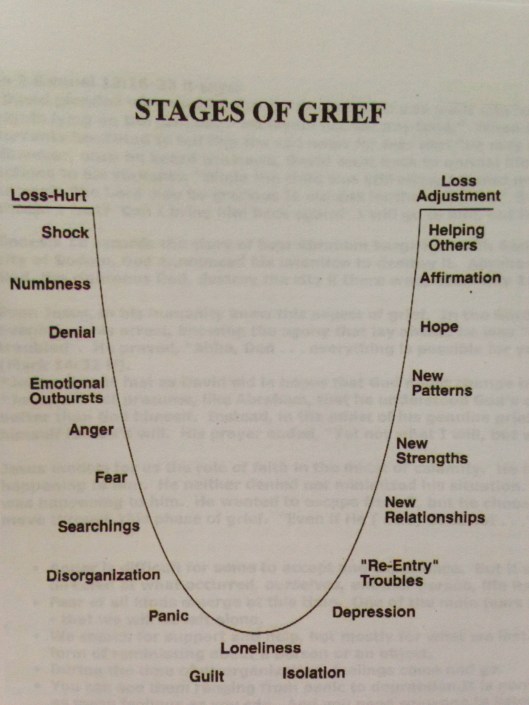
Now I want to share this with other people, and also to figure out what this means on the employment front. How we can use this to really help organizations understand the absurdity of a 3-day bereavement leave, how to deal with work that needs to be done by employees on this grief journey. Because, believe me, grief changes a person. The employee you saw yesterday is not the same one you’ll see tomorrow. Nor will the husband or best friend or neighbor or aunt be unchanged by this experience. As a society, we seem to stop talking about this out loud after the funeral…and even then, it’s in hushed tones. I’d like to help people get okay with death, to not see it as a failure, to get comfortable with grief, and open up discussions about our spiritual paradigms. Let’s find a way to acknowledge the grief journey.
 in front of the computer or the TV all day. I understand now what you must have gone through, now that I’m home all day (well, most of the day, most of the time). You were always so patient with me, telling me the trivia of your day, and asking about mine. I took for granted the lawn being mowed or the dogs being cared for or the trash being out at the curb for pickup because you never made a big deal out of that.

 pity party because no one knows how I feel, I remember that you knew. You carried the load much of the time, even when I didn’t realize it or appreciate it. You give me strength now, too. I am so damn lucky to have you in my life. I wanted you to know that. I still love you, but I think I love you better now.

 I watched complete movies and read entire books instead of just pages. I continued the updates in the house, and Peggy fixed the hole in the wall. She came here, and I went to her house also. In August I was ready for a vacation, and rode my motorcycle again. I noted I was feeling more like me again. It was now I started thinking about writing a book on the grieving experience. But for some reason I also started worrying about money, and I thought about moving. September I met with a realtor about selling the house, but had out of state work trips to Minnesota and Seattle, and made a side trip to Los Angeles, so no time to decide.







 inishing this post will make No. 7. One of the items was to check my access to the John Maxwell Team resources, since I haven’t been on that site in a v-e-r-y long time, and I am interested in starting up another study session of the 21 Irrefutable Laws of Leadership. I not only was able to sign in immediately, but I then listened to two archived calls, one by Malissa West and one by
 Paul Martinelli, for nearly 2 hours of webinar time. I also did a bit of research on local professional photographers for a head shot session and responded to several emails related to the NSA Speaker Academy course I am enrolled in. I’ve spent less than a half hour on Facebook and that was only to check out the John Maxwell Group’s site.
 Staying social was one of my other rules, and I haven’t broken that one. I know how important it is to be connected and feel like I belong. Funny thing about that – twice in the past two days, I have gone somewhere and ran into people I know. One was my neighbor when I went to a coffee date, and another was a fellow Toastmaster when I went to dinner last night. There’s nothing like being recognized outside of the usual context of where we know people from. It’s one thing to have a planned meeting; it’s another when getting dressed and going out results in not just a casual hello but a conversation. So it seems like another good reason to get out of pajamas – you never know when you’ll want to step out or be invited to coffee.


